Safety, braking and stopping distances
Mastering the distance calculation formulae and understanding the 2-second rule to maintain the correct gap.
Updated 13 June 2026
Reaction time: an irreducible 1 second
Reaction time is the delay between the moment you perceive a danger and the moment you begin to act on the controls (braking, turning). For a driver in full form, this time is roughly 1 second. During this second, your vehicle continues at the same speed, on the same course, without slowing down.
No vehicle equipment can reduce your reaction time. Only anticipation (placing your foot near the brake in expectation of a hazard) can shorten it. Conversely, fatigue, alcohol, drugs, medication or phone use lengthen it considerably (up to 2 seconds or more).
Calculating the distance covered during reaction time
The formula is simple: take the tens digit of your speed and multiply it by 3. This gives you the distance covered in 1 second, i.e. during the reaction time.
At 50 km/h: 5 x 3 = 15 metres (the length of a bus). At 90 km/h: 9 x 3 = 27 metres. At 130 km/h: 13 x 3 = 39 metres (the length of a hard shoulder section).
At 50 km/h, before you have even begun to brake, you have already covered 15 metres. If a pedestrian steps out in front of a bus you are overtaking, they will be hit before you have touched the brake pedal.
Braking distance
This is the distance covered between the moment you press the brake and the vehicle coming to a complete stop. It depends essentially on the speed and the grip of the road surface.
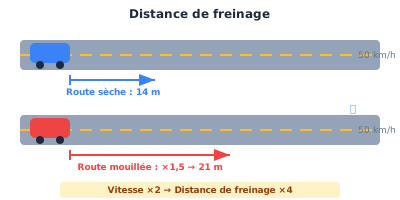
When speed doubles, braking distance is multiplied by 4 (not by 2). On a wet road, it is multiplied by 2 compared to a dry road.
Loss of grip can also come from fallen leaves, mud, gravel, snow or ice. On black ice, grip is virtually non-existent and the risk of losing control is at its highest. Note that neither ABS nor good tyres reduce the braking distance: ABS prevents the wheels from locking to maintain steering, but does not shorten the stop.
Total stopping distance: the formula to remember
The stopping distance is the distance covered during reaction time plus the braking distance. To calculate it quickly, use this fundamental formula:
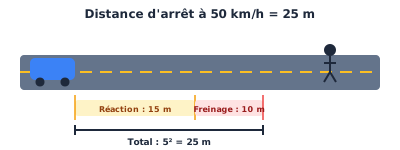
Stopping distance = (tens digit of speed) squared. Simply take the tens digit and multiply it by itself. This is the 'speedometer divided by 10, squared' formula.
At 50 km/h: 5 x 5 = 25 metres (a tennis court). At 90 km/h: 9 x 9 = 81 metres. At 130 km/h: 13 x 13 = 169 metres (one and a half football pitches).
On a wet road, add half the dry-road result. Examples: at 50 km/h, 25 + 12.5 = roughly 38 metres. At 90 km/h, 81 + 40.5 = roughly 122 metres. At 130 km/h, 169 + 84.5 = roughly 254 metres.
The safety distance: the 2-second rule
The safety distance is the minimum gap to maintain between your vehicle and the one ahead. It corresponds to the distance covered in 2 seconds. To calculate it: multiply the tens digit of the speed by 6.
At 50 km/h: 5 x 6 = 30 metres. At 100 km/h: 10 x 6 = 60 metres. At 130 km/h: 13 x 6 = 78 metres (we round to about 90 metres, i.e. 2 hard shoulder markings on a motorway).
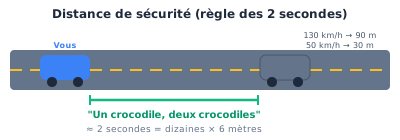
Practical tip: when the vehicle ahead passes a fixed reference point (tree, post), say 'one crocodile, two crocodiles'. If you reach the reference before finishing, you are too close.
Gauging the safety distance on motorways and in tunnels
On a motorway, the minimum safety distance corresponds to 2 hard shoulder markings (each marking measures roughly 40 metres). If you can see only one marking between you and the vehicle ahead, it is dangerous. In some tunnels, blue LED markers serve the same purpose: leave 2 blue markers between you and the vehicle in front.
Lateral safety distance
When overtaking pedestrians, cyclists or any vulnerable road user, you must maintain a minimum lateral distance. In built-up areas, it is at least 1 metre. Outside built-up areas, it increases to 1.50 metres. If this distance cannot be maintained (road too narrow), reduce your speed to walking pace before overtaking.
The lateral safety distance is roughly equivalent to a fully opened car door. Keep this image in mind to gauge it visually.
When stopped: seeing the wheels of the vehicle ahead
When you stop behind another vehicle, you must be able to clearly see its rear wheels touching the ground. This guarantees enough space to manoeuvre around it if it cannot move off, and prevents you from hitting it if a vehicle strikes you from behind.
Summary of formulae
Reaction distance (1 s) = tens x 3. Safety distance (2 s) = tens x 6. Stopping distance = tens x tens (squared). Wet road: stopping distance x 1.5.
Recap
- The average reaction time is 1 second. It increases with fatigue, alcohol, drugs or phone use.
- Reaction distance = tens of speed x 3 (e.g. at 50 km/h, 15 m covered in 1 s).
- Stopping distance = tens of speed squared (e.g. at 50 km/h, 25 m; at 130 km/h, 169 m).
- On a wet road, stopping distance is multiplied by 1.5 and braking distance by 2.
- Safety distance = tens x 6, corresponding to a minimum 2-second gap.
- On a motorway: 2 hard shoulder markings between you and the vehicle ahead.
- Lateral distance: 1 m in built-up areas, 1.50 m outside built-up areas to overtake a vulnerable road user.
- Neither ABS nor good tyres shorten the braking distance.
- When stopped, you must be able to see the rear wheels of the vehicle ahead touching the ground.
Test yourself
What is the approximate stopping distance at 90 km/h on a dry road?
- ○27 metres
- ○54 metres
- ✓81 metres
- ○122 metres
Correct answer : 81 metres
On a wet road, by how much is the braking distance multiplied?
- ○By 1.5
- ✓By 2
- ○By 3
- ○By 4
Correct answer : By 2
Sources: Sécurité routière (securite-routiere.gouv.fr) and service-public.fr.