Motorway driving
Everything you need to know to enter, drive on and leave the motorway safely.
Updated 13 June 2026
Characteristics of the motorway
The motorway is a fast road made up of single-direction carriageways separated by a central reservation. It has no intersections and does not pass through built-up areas. It is identified by its blue sign and the letter 'A' followed by a number. Certain users are not permitted: pedestrians, cyclists, moped riders, microcars, agricultural tractors and unregistered vehicles. Their low speed would pose a danger to others.
The motorway is reserved for motor vehicles capable of travelling at high speed. All slow users are excluded.
Entering the motorway: the acceleration lane
Entry takes place in two stages. First, you take a slip road, often curved and with a speed limit. Then you accelerate in the merging lane to approach the speed of the traffic. This lane always ends with a 'Give Way': you therefore do not have priority over vehicles already on the motorway.
During merging, activate your indicator, check your mirrors and blind spot, then choose the right moment to slot into the flow. If the lane is congested, adjust your speed to find a gap, but never stop in the merging lane except in an emergency.
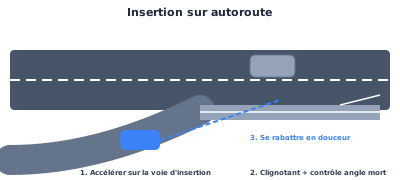
It is prohibited to stop on the acceleration lane. Prepare your merge as early as possible, as soon as the white line becomes broken.
Driving on the motorway
In normal driving, always use the right-hand lane. The left-hand lanes are only for overtaking. On a three-lane carriageway, vehicles over 3.5 tonnes or over 7 metres long may not use the left-hand lane. To use this lane, you must be travelling at a minimum of 80 km/h.
The safety distance corresponds to 2 seconds, i.e. roughly 2 hard shoulder markings at 130 km/h (approximately 90 metres).
Overtaking is only permitted on the left. Before overtaking, check your mirrors and blind spot several times, activate your indicator and keep it on throughout the manoeuvre. Move back when the overtaken vehicle appears entirely in your interior mirror. On a motorway, you may overtake several vehicles in one go.
Speeds and limits
Maximum speeds on the motorway vary according to conditions. In dry weather, the general limit is 130 km/h (110 km/h on peri-urban sections). In rain or for a driver in the probationary period, these limits are lowered to 110 km/h and 100 km/h respectively. When visibility drops below 50 metres, the maximum speed becomes 50 km/h regardless of the section.
Watch for specific speed limit signs that may appear temporarily, for example near roadworks or accident-prone zones.
Strictly prohibited manoeuvres
On the motorway, certain actions are formally prohibited and result in immediate licence suspension: making a U-turn, reversing (even on the hard shoulder), driving on the hard shoulder to overtake, or crossing the central reservation. If you miss your exit, continue to the next one.
A U-turn or reversing on a motorway constitutes a serious offence that may result in the immediate suspension of your driving licence.
Leaving the motorway
The exit is prepared in advance. Move back to the right-hand lane as soon as you spot the exit signs, activate your indicator and only begin to slow down once you are in the deceleration lane. The limit there is often 90 km/h, sometimes 70 or even 50 km/h: check the signs. After a long high-speed journey, your perception of speed is distorted: check your speedometer regularly.
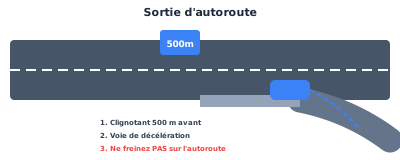
Watch out for the deterrent line placed before certain exits: it prevents vehicles that are overtaking from suddenly cutting back towards the exit.
Breakdown and emergency stop
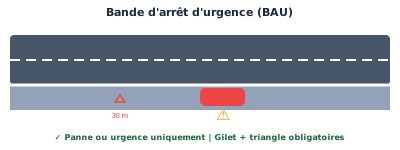
In the event of a breakdown, switch on your hazard lights, slow down and pull onto the hard shoulder or an emergency lay-by. Put on your high-visibility vest and stand behind the safety barriers. On a motorway, it is too dangerous to place the warning triangle. Contact the emergency services via the emergency phones located every 2 km: they allow precise location.
Toll booths and rest areas
Most motorways have toll booths. You generally take a ticket at the entrance and pay at the exit, according to the distance and vehicle category. Identify the open lanes (green arrow) and closed ones (red cross). Do not confuse the 'T' logo for ticket collection with the orange 'T' for electronic tolling: the latter allows you to pass without stopping, provided you do not exceed 30 km/h. If you find yourself in the wrong toll lane, never reverse: switch on your hazard lights and use the intercom to contact staff.
For long journeys, take a break of at least 15 minutes every 2 hours. Simple rest areas offer a space to relax and have a picnic, whilst service areas also provide filling stations, restaurants and play areas. Fatigue and drowsiness are responsible for a third of fatal motorway accidents: at the slightest sign of tiredness, stop.
Recap
- The motorway is prohibited for pedestrians, cyclists, moped riders and slow vehicles.
- Merging is done via the acceleration lane. You never have priority when entering.
- Always drive as far right as possible; the left-hand lanes are only for overtaking.
- The safety distance is 2 seconds, i.e. roughly 90 m at 130 km/h (2 hard shoulder markings).
- Maximum speed: 130 km/h (dry weather), 110 km/h (rain or novice driver), 50 km/h (visibility below 50 m).
- U-turns, reversing and driving on the hard shoulder are strictly prohibited.
- In the event of a breakdown, switch on your hazard lights, put on your vest and stand behind the barriers.
- Take a break of at least 15 minutes every 2 hours to combat fatigue.
Test yourself
What must you do when reaching the end of the motorway merging lane?
- ○Stop and wait for a gap
- ✓Give way to vehicles already on the motorway
- ○Accelerate and force your way in
- ○Sound your horn to signal your arrival
Correct answer : Give way to vehicles already on the motorway
What is the minimum safety distance at 130 km/h on a motorway?
- ✓Approximately 90 metres, i.e. 2 hard shoulder markings
- ○50 metres
- ○130 metres
- ○Approximately 60 metres, i.e. 1 hard shoulder marking
Correct answer : Approximately 90 metres, i.e. 2 hard shoulder markings
Sources: Sécurité routière (securite-routiere.gouv.fr) and service-public.fr.