Dashboard and warning lights
Understanding the gauges, dials and colour-coded warning lights to respond correctly to vehicle alerts.
Updated 13 June 2026
The dashboard: your information panel
The dashboard brings together all the dials, gauges and warning lights that continuously inform you about the vehicle's condition and driving status. Although the layout varies between models, the main indicators are always present and it is essential to know how to read them.
The four main gauges
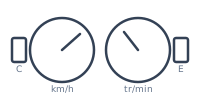
The speedometer shows your speed in km/h. It is compulsory: driving with a faulty speedometer is an offence.
The rev counter displays the number of revolutions the engine makes each minute. It is a valuable aid for eco-driving: running at low revs reduces fuel consumption. You generally change up at around 2,000–2,500 rpm (petrol) or 1,500–2,000 rpm (diesel).
The fuel gauge shows the remaining fuel level. When the warning light comes on, you are running on the reserve, which allows you to travel roughly 50 km depending on the vehicle. Avoid driving on the reserve frequently: impurities at the bottom of the tank can damage the engine.
The coolant temperature indicator should stabilise at around 90 °C during normal operation. If the temperature exceeds this value and continues to rise, there is a serious problem in the cooling system: stop immediately.
Four essential gauges: speed (compulsory), rev counter (eco-driving), fuel and engine temperature (90 °C during normal operation).
The colour code of warning lights
The dashboard warning lights follow a universal colour code that you absolutely must know.
Red lights signal immediate danger. When a red light comes on whilst driving, you must stop as soon as possible. Continuing to drive risks seriously damaging the engine or causing an accident.
Orange lights indicate a potential problem or a function to monitor. They do not require an immediate stop but call for a prompt check.
Green and blue lights simply confirm that a piece of equipment is active: lights on, cruise control engaged, etc.
Red = immediate danger (stop). Orange = monitor. Green/blue = equipment operating.
The main red warning lights
The oil light (oil can symbol) indicates an insufficient oil level. The engine is no longer adequately lubricated and parts may break. If the light stays on despite a good level, the oil may be dirty: head to the mechanic.
The temperature light (thermometer in water) signals engine overheating due to a lack of coolant. Never open the cap when the engine is hot: risk of serious burns.
The brake light signals a drop in braking circuit pressure or a brake fluid level that is too low. Braking capacity is compromised: this is very dangerous.
The battery light indicates that the battery is no longer supplying electricity or that a terminal has come loose. Always keep a set of jump leads in the boot for emergencies.






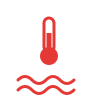
Red light on whilst driving = compulsory stop as soon as possible. Never continue your journey.
The main orange warning lights
The fuel light indicates that the reserve has been reached. The engine light (engine symbol) signals a mechanical or emissions fault: visit a mechanic promptly. The tyre pressure light signals an inflation defect to check manually. The brake pad light indicates that they are worn and need replacing.













Steering column controls and the ventilation unit
The stalks are the two levers on either side of the steering wheel. The left one controls the indicators (down = left, up = right). The right one operates the windscreen wipers. The ventilation unit heats or cools the cabin, demists and defrosts the windows. Blue indicates cold air, red indicates hot air.
Sun visors are very useful when exiting tunnels to avoid glare. You can unclip them and fold them against the side window if the sun is coming from the side.

Recap
- The speedometer is compulsory; driving with a faulty one is an offence.
- The rev counter aids eco-driving: change up between 1,500 and 2,500 rpm.
- Engine temperature should stabilise at 90 °C; above that, stop immediately.
- Colour code: red = immediate stop, orange = prompt check, green/blue = normal operation.
- Oil, temperature, brake or battery light in red: do not continue driving.
- The engine light (orange) requires a prompt visit to the mechanic.
- The fuel reserve allows you to travel roughly 50 km depending on the vehicle.
- Never open the cooling system when the engine is hot: risk of serious burns.
Test yourself
What should you do when a red warning light comes on whilst driving?
- ✓Stop as soon as possible
- ○Continue to the next petrol station
- ○Wait to see if it goes off
- ○Speed up to reach a mechanic faster
Correct answer : Stop as soon as possible
At what temperature should the coolant stabilise during normal operation?
- ○60 °C
- ○75 °C
- ✓90 °C
- ○110 °C
Correct answer : 90 °C
Sources: Sécurité routière (securite-routiere.gouv.fr) and service-public.fr.