Speed limits
Knowing all maximum permitted speeds according to road type, weather and driver profile, and understanding the penalties involved.
Updated 13 June 2026
Why speed is a major issue
Excessive or inappropriate speed remains the leading factor in fatal accidents in France, ahead of alcohol. A responsible driver must not only obey the displayed limits but also adapt their speed to every situation encountered.
There are two distinct concepts: speeding (exceeding the permitted limit) and excessive speed (driving too fast for the conditions, even below the limit).
The higher the speed, the more severe the consequences. The stopping distance increases considerably, the field of vision narrows (tunnel effect), fatigue increases and the kinetic energy in a collision grows with the square of the speed: doubling the speed produces a collision four times more violent.
Limits by road type
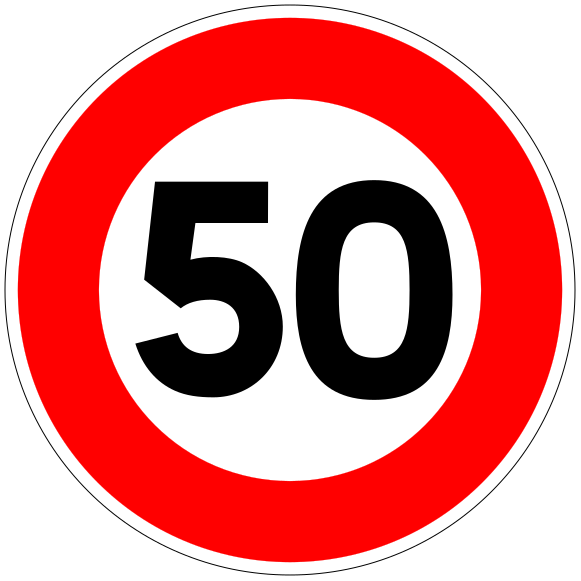
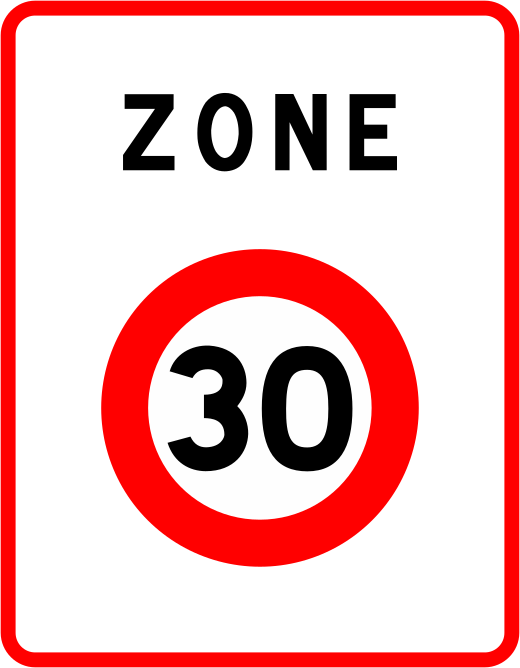
In built-up areas, the speed limit is 50 km/h. Some zones can lower this limit (Zone 30, shared zone at 20 km/h, pedestrian area at 6 km/h).
On two-way roads without a central reservation, the limit is 80 km/h. The department or local authority may raise this limit to 90 km/h on certain sections, indicated by signs.
On roads with carriageways separated by a central reservation (or roads with regulated access), the limit rises to 110 km/h. On motorways, it is 130 km/h. Motorway or expressway entry signs remind you of the applicable limit.
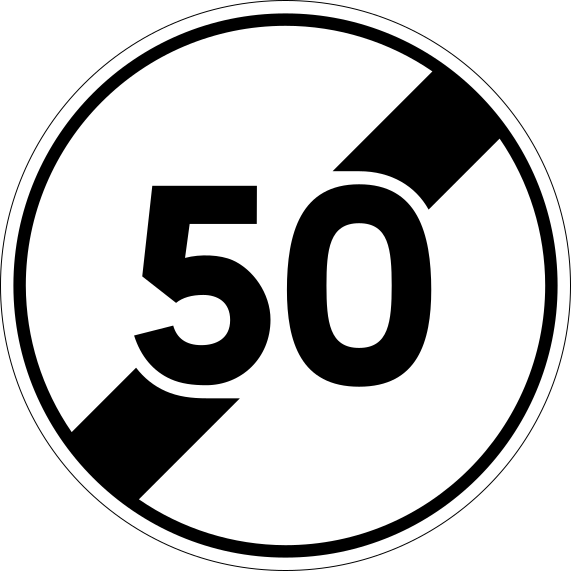
A limit indicated by a sign takes effect at the sign and ends at the next junction or the next end-of-limit sign. Zone signs (Zone 30, for example) only end at the end-of-zone sign.
Reduction in wet weather
As soon as the road is wet, the limits are lowered: 110 km/h on motorways (instead of 130), 100 km/h on dual carriageways (instead of 110), and 80 km/h on two-way roads (unchanged). In built-up areas, the limit remains 50 km/h. These reductions apply automatically, without any special sign: it is up to the driver to know the rule and apply it.
Memory tip: wet-weather speeds correspond to young drivers' speeds in dry weather.
Limits for new drivers
During the probationary period (3 years after obtaining the licence, or 2 years with accompanied driving), the limits are reduced: 110 km/h on motorways, 100 km/h on dual carriageways, and 80 km/h on two-way roads. In town, the limit remains 50 km/h.
New driver speed = wet-weather speed. One single table to remember for both cases.
Visibility below 50 metres
When fog, heavy rain or snow reduces visibility to less than 50 metres, the speed limit is 50 km/h on all roads, including motorways.
Adapting your speed beyond the signs
Obeying the limit is not always enough. You must reduce your speed outside a school, when encountering pedestrians or cyclists, in bends, in poor visibility, approaching the brow of a hill, when passing animals or stationary convoys, and on a slippery road. The Highway Code requires the driver to remain constantly in control of their speed and to adapt it to circumstances.
When approaching any danger sign, slow down. In built-up areas, adopt roughly 30 km/h until the hazard is clearly identified and passed. If the surroundings are unclear and visibility is poor, prepare to brake by placing your foot over the brake pedal.
Excessive speed for the circumstances is punished with a 135-euro fine, even if you were below the displayed limit. No penalty points, but criminal liability applies in the event of an accident.
Speed cameras and tolerance
Fixed cameras apply a margin of 5 km/h below 100 km/h and 5% above. Mobile cameras deduct 10 km/h below 100 km/h and 10% above. The advisory camera does not issue fines: it simply displays your speed to encourage you to slow down. The average-speed camera measures your average speed over a stretch of road.
Penalties for speeding
An excess of 1 to 19 km/h costs 1 point and a fine of 68 euros (outside built-up areas) or 135 euros (in a 50 km/h zone). 20 to 29 km/h: 2 points and 135 euros. 30 to 39 km/h: 3 points, 135 euros and risk of suspension for up to 3 years. 40 to 49 km/h: 4 points, 135 euros, suspension and possible confiscation. Over 50 km/h: 6 points, fine up to 1,500 euros, 3-year suspension without reprieve and vehicle confiscation.
An excess of 50 km/h or more during the probationary period results in the immediate invalidation of the licence, with no possibility of a points-recovery course.
Recap
- In town: 50 km/h. Two-way road: 80 km/h. Dual carriageway: 110 km/h. Motorway: 130 km/h.
- In wet weather: 110 / 100 / 80 km/h (motorway / dual carriageway / two-way).
- New driver = same limits as in wet weather.
- Visibility below 50 m: 50 km/h everywhere.
- Excessive speed (inappropriate for the situation) is an offence, even below the limit.
- Fixed cameras: margin of 5 km/h (or 5%). Mobile cameras: margin of 10 km/h (or 10%).
- Over 50 km/h excess: 6 points, 1,500 euros and 3-year suspension.
- Special zones: Zone 30, shared zone (20 km/h), pedestrian area (6 km/h).
Test yourself
What is the maximum speed on a motorway in wet weather?
- ○130 km/h
- ○100 km/h
- ✓110 km/h
- ○90 km/h
Correct answer : 110 km/h
On a two-way road without a central reservation, the general limit is:
- ✓80 km/h
- ○90 km/h
- ○110 km/h
- ○70 km/h
Correct answer : 80 km/h
Sources: Sécurité routière (securite-routiere.gouv.fr) and service-public.fr.