Crossing and overtaking
Knowing how to cross and overtake safely: rules, prohibitions, lateral distances and special situations in the mountains.
Updated 13 June 2026
Crossing: passing a vehicle coming the other way
Crossing another vehicle coming in the opposite direction is always done on the right. Slow down and move to the right to maintain sufficient space and avoid any collision. Be particularly attentive on narrow roads and at night. If the vehicles are bulky (over 2 metres wide or 7 metres long), the larger one must make way for the smaller, except for buses in built-up areas, to which you must always give way.
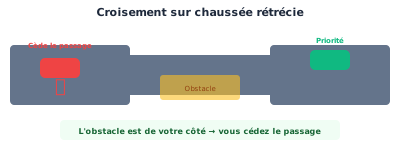
Crossing with an obstacle
If an obstacle (parked vehicle, roadworks) is on your side of the carriageway, it is up to you to give way to the oncoming vehicle. You must wait until the road is clear before going around the obstacle.
Simple rule: the one with the obstacle in their lane gives way to the one coming from the opposite direction.
Crossing on a slope (mountains)
In the mountains, when crossing is difficult or even impossible, specific rules apply to determine who must stop or reverse.
Between vehicles of the same size: the vehicle going uphill has priority. The one going downhill must stop or reverse to clear the way.
Between a light vehicle and a heavy vehicle: the heavy vehicle has priority, whether going uphill or downhill. It is the light vehicle that reverses.
Between a vehicle on its own and a vehicle with a trailer: the vehicle with the trailer has priority in all cases (reversing with a trailer is much more difficult).
Between a lorry and a coach: the coach (passenger transport) has priority, whether going uphill or downhill. The lorry reverses.
In summary for the mountains: the hardest to manoeuvre goes first. Passengers > goods, heavy > light, trailer > solo, uphill > downhill.
Overtaking: the preconditions
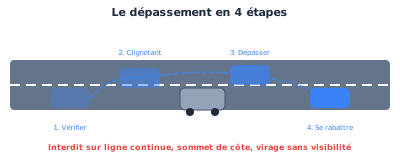
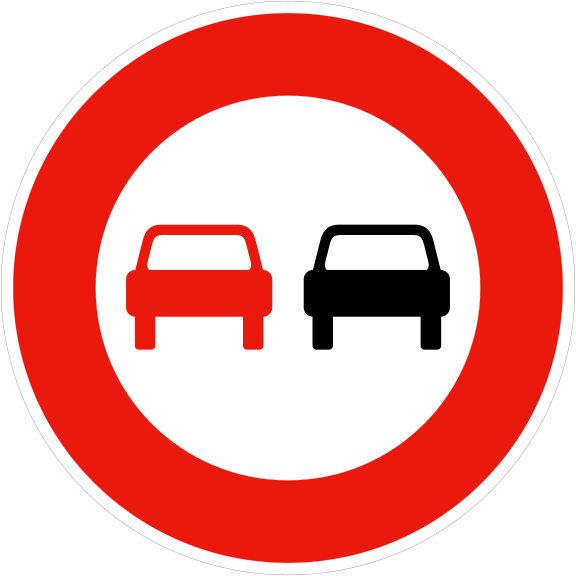

Overtaking is always done on the left. Before overtaking, check four conditions: the signage permits it (no prohibition sign, no continuous line), visibility is sufficient ahead and behind, you will not exceed the speed limit, and no oncoming vehicle is likely to impede you.
To overtake safely, you need to drive roughly 20 km/h faster than the vehicle being overtaken, whilst remaining below the speed limit.
Overtaking prohibitions
Overtaking is forbidden in the following situations: at the brow of a hill, on a bend without visibility, near an intersection, approaching a level crossing, in dense fog or heavy rain, and when a pedestrian is on a protected crossing.
Road markings also guide your decision. The continuous line prohibits all crossing. The broken line permits overtaking. The mixed line: look at the line on your side. The dissuasion line (long dashes, short gaps) only permits overtaking very slow vehicles.
Crossing a continuous line to overtake is punished with a 135-euro fine and 3 penalty points.
How to carry out an overtaking manoeuvre
Before: check the mirrors (interior and exterior), activate the left indicator, check the blind spot with a direct look. During: accelerate whilst obeying the limit, maintain a safe lateral gap. After: check in the interior mirror that you can see the overtaken vehicle in full, then activate the right indicator and move back into lane smoothly.
Compulsory lateral gap: at least 1 metre in built-up areas and 1.50 metres outside built-up areas when overtaking pedestrians, cyclists, horse riders or animals.
Special overtaking cases
Overtaking on the right is only permitted if the vehicle ahead has signalled that it is turning left and there is sufficient space. Moving past an unbroken queue on the right is not considered overtaking.
At night outside built-up areas, stay on dipped headlights while behind the vehicle to avoid dazzling them in their mirrors. Switch to full beam only when you draw level and your lights are no longer likely to trouble oncoming road users.
You may overtake several vehicles in a single manoeuvre, but only if you have sufficient visibility and space to complete the entire overtake and move back safely. If in doubt, overtake one vehicle at a time.
It is forbidden to overtake a winter service vehicle (snowplough) on duty. Never overtake a lorry on the right: on a bend, it may swing left before turning right.
Being overtaken: the right behaviour
When a vehicle overtakes you, never accelerate. Move to the right and maintain your speed, or even slow down if a road user is coming the other way. At night, switch to dipped headlights as soon as the vehicle draws level. On a wet road, switch on the wipers to anticipate spray.
Recap
- Crossing is done on the right; the one with the obstacle gives way.
- In the mountains: priority to the one going uphill (same size), to the heavier, to the vehicle with a trailer, to the coach over the lorry.
- Overtaking is done on the left, at roughly 20 km/h more, without exceeding the speed limit.
- Forbidden to overtake at the brow of a hill, on a bend, near an intersection or a level crossing.
- Lateral distance: 1 m in town, 1.50 m outside built-up areas for vulnerable road users.
- After overtaking: move back when you can see the vehicle in full in the interior mirror.
- Being overtaken: never accelerate, move to the right, keep the same speed.
Test yourself
In the mountains, two vehicles of the same size cannot cross. Who must reverse?
- ○The vehicle going uphill
- ✓The vehicle going downhill
- ○The smaller of the two
- ○The one that arrived last
Correct answer : The vehicle going downhill
What is the minimum lateral distance for overtaking a cyclist outside built-up areas?
- ✓1.50 metres
- ○1 metre
- ○50 centimetres
- ○2 metres
Correct answer : 1.50 metres
Sources: Sécurité routière (securite-routiere.gouv.fr) and service-public.fr.