Stopping and parking
Distinguishing stopping from parking, knowing the permitted and prohibited zones, and avoiding the most common penalties.
Updated 13 June 2026
Stopping or parking: what is the difference?
Stopping corresponds to the momentary immobilisation of the vehicle to allow passengers to board or alight, or goods to be loaded or unloaded. The driver remains in the immediate vicinity, ready to move the vehicle at any moment.
Parking refers to any other immobilisation of the vehicle. As soon as you leave the vehicle — even for a minute at the bakery — or remain on board without loading or unloading (for example, to make a phone call), you are in a parking situation.
The distinction matters: some places prohibit parking but allow stopping (for example, delivery bays or double parking).
Where can you stop and park?
In built-up areas: in designated spaces or along the kerb, always in the direction of traffic. Parking against the flow is forbidden because it forces you to cross the carriageway dangerously and reduces visibility when setting off.
Outside built-up areas: preferably off the carriageway, on the hard shoulder if it is wide enough. Always in the direction of travel.
The three types of parking
Parallel: the vehicle is placed along the kerb, parallel to it. Bay (perpendicular): the vehicle is at right angles to the carriageway. Echelon (angled): the vehicle is placed at an angle. When possible, prefer reversing into the space: you will have better visibility when pulling out.
Reversing into a space reduces risks: when leaving the space, you see the road directly instead of reversing blindly into traffic.
Regulated parking


Paid parking is managed by a parking meter. After paying, place the ticket visibly behind the windscreen. Respect the indicated duration.
In a blue zone, parking is free but limited in duration. You must place a parking disc behind the windscreen showing your time of arrival. The maximum duration is specified by a sub-sign (often 1 hour 30 minutes).
Alternate semi-monthly single-side parking
In some streets, parking is only allowed on one side, alternating according to the period of the month. From the 1st to the 15th: the odd-numbered side. From the 16th to the last day of the month: the even-numbered side. The changeover takes place on the last day of each period. When this sign is combined with the town-entry sign, the rule applies to all streets in the town.
No-stopping and no-parking restrictions

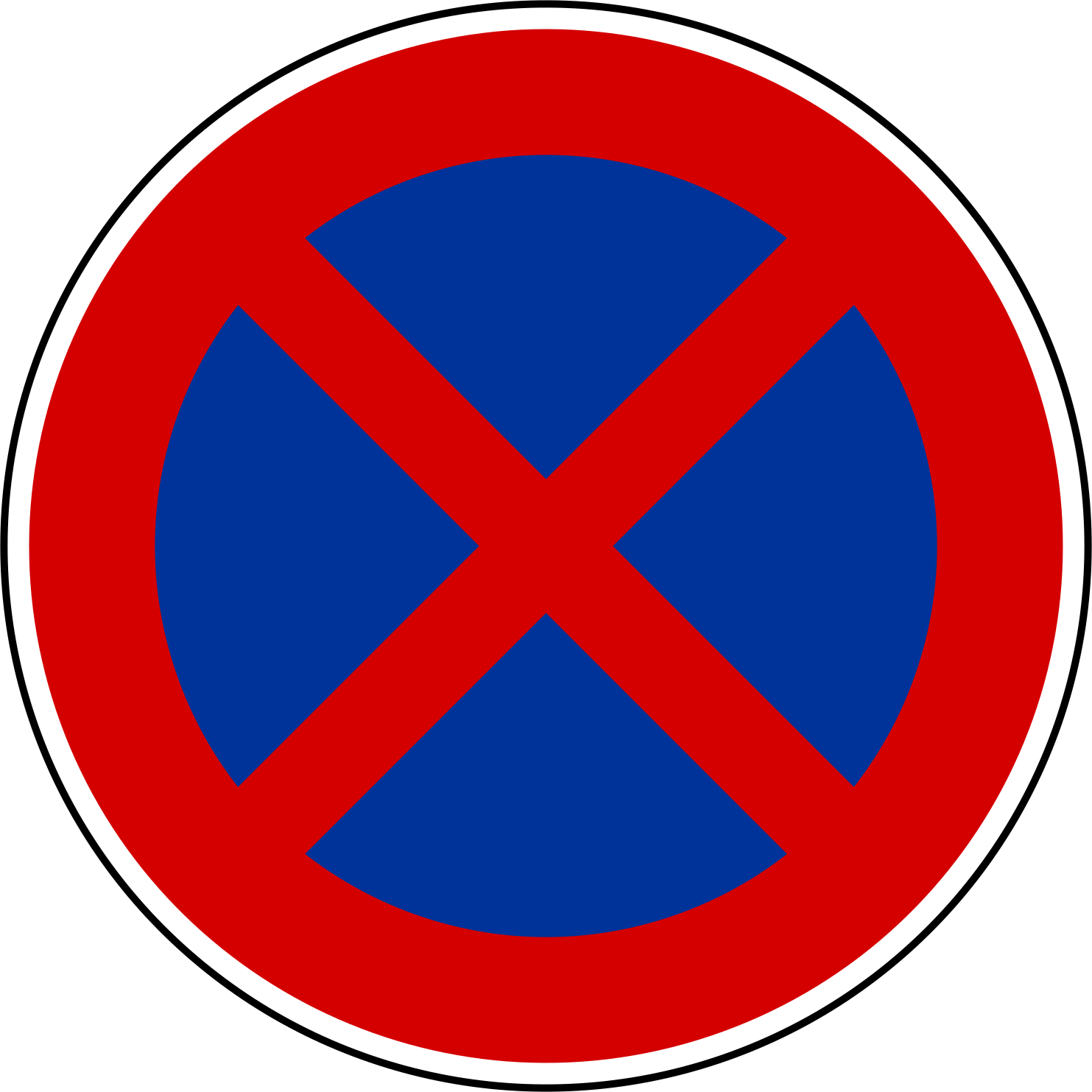
Stopping and parking are strictly forbidden: when signage indicates it, on reserved lanes (buses, cycle lanes, pedestrian crossings), and on motorways (except emergency stops on the hard shoulder).
Parking alone is forbidden (stopping tolerated): in double file, in front of garage entrances, on delivery bays (unless a sub-sign permits certain time slots), and in front of electric charging points.
Road markings also help you understand the rules. A continuous yellow line along the kerb prohibits stopping and parking. A broken yellow line (dots) prohibits parking but allows stopping.
Dangerous, obstructive and abusive parking
Dangerous parking increases the risk of collision. This is the case when you park at night outside built-up areas without lights, near a bend, the brow of a hill, an intersection or a level crossing.
Obstructive parking (or very obstructive parking) prevents other road users from circulating normally: on a pavement, a pedestrian crossing, a cycle lane, within 5 metres before a pedestrian crossing, in front of a fire hydrant, on a bridge or in a tunnel. Fine: 135 euros for very obstructive parking.
Abusive parking refers to leaving a vehicle in the same place for more than 7 consecutive days (or fewer according to local regulations). You risk having your vehicle impounded.
Never occupy a space reserved for disabled persons, even for a brief stop. The fine is 135 euros and impounding is possible.
Parking at night
If your vehicle is parked off the carriageway, no lighting is needed. In a lit built-up area on the carriageway, no lights either. However, outside built-up areas on the carriageway, switch on the sidelights (or parking lights) on the traffic side. Never leave the dipped headlights on: they drain the battery.
Reserved spaces
Some spaces are reserved exclusively for a category of user: disabled persons (parking card required), buses, taxis, car-sharing, or deliveries. Never occupy these spaces if you are not authorised, even for a short moment.
Recap
- Stopping = brief immobilisation, driver present. Parking = any other immobilisation.
- Always park in the direction of traffic, preferably by reversing in.
- Blue zone: disc required, limited duration, free.
- Semi-monthly alternation: odd numbers from the 1st to the 15th, even numbers from the 16th to the 31st.
- Forbidden to park on a pavement, pedestrian crossing, cycle lane, or within 5 m of a pedestrian crossing.
- Dangerous parking: at night without lights, bend, brow of a hill, intersection.
- Abusive parking: more than 7 days in the same place = risk of impounding.
- Never occupy a disabled space without a card, even for a stop.
Test yourself
You immobilise your vehicle to go and buy bread. Are you stopping or parking?
- ○Stopping, because it is brief
- ✓Parking, because you leave the vehicle
- ○Stopping if it is less than 5 minutes
- ○It depends on the signage
Correct answer : Parking, because you leave the vehicle
In a blue zone, what must you place behind your windscreen?
- ✓A parking disc showing your time of arrival
- ○A parking meter ticket
- ○Your vehicle registration document
- ○A sticker from the town hall
Correct answer : A parking disc showing your time of arrival
Sources: Sécurité routière (securite-routiere.gouv.fr) and service-public.fr.